Last novembre, on a cold sunny day, we drove from Lucca into the Garfagnana region, to catch the woods in their autumnal splendour, before winter settled in.
Sillico was our destination: a minuscule, picture-perfect village, perched 700 meters above sea level on the Tuscan-Emilian Apennines, surrounded by chestnut woodland.
Only about one hundred people live here permanently: there is no school, no doctor, and only one “alimentari” that doubles as a bar and as a restaurant – the hub of the village. Sillico is a charming spot, but living here could be challenging, I thought.
The air was brisk and we could smell wood being burned in the fireplaces, as we meandered the deserted, cobbled alleys, being grateful we were wearing warm clothes.
We were more than peckish by the time we finally stepped into the Locanda Belvedere, whose name and menu had already given me hope when I was researching the area at home.
You know that feeling when you walk into a restaurant for the fist time and you start chuckling to yourself because you can sense you have stricken gold and have stumbled upon a little gem? The Locanda Belvedere gave me that thrill. A burner efficiently doing its job in a corner, a substantial wood dresser matronly presiding over the room along a wall, in the air the contented humming of other customers already settled and seated: everything somehow foretold of good things to come. So it was.
The menu ran along the customary, reassuring tracks for this type of restaurants: locally sourced pecorino and ham (more savoury than Parma ham and sliced by hand), home-made pickles, fried ceps, vegetable timbales, tagliatelle with ragu’ and with ceps, the ever-present polenta with wild board stew (plenty of wild boars on these mountains), walnut and dry fig crostata.
We ate well and all dishes spoke of a cook who did not want to impress customers with special effects. The goal here was to be make eaters content and satisfied – mission accomplished.
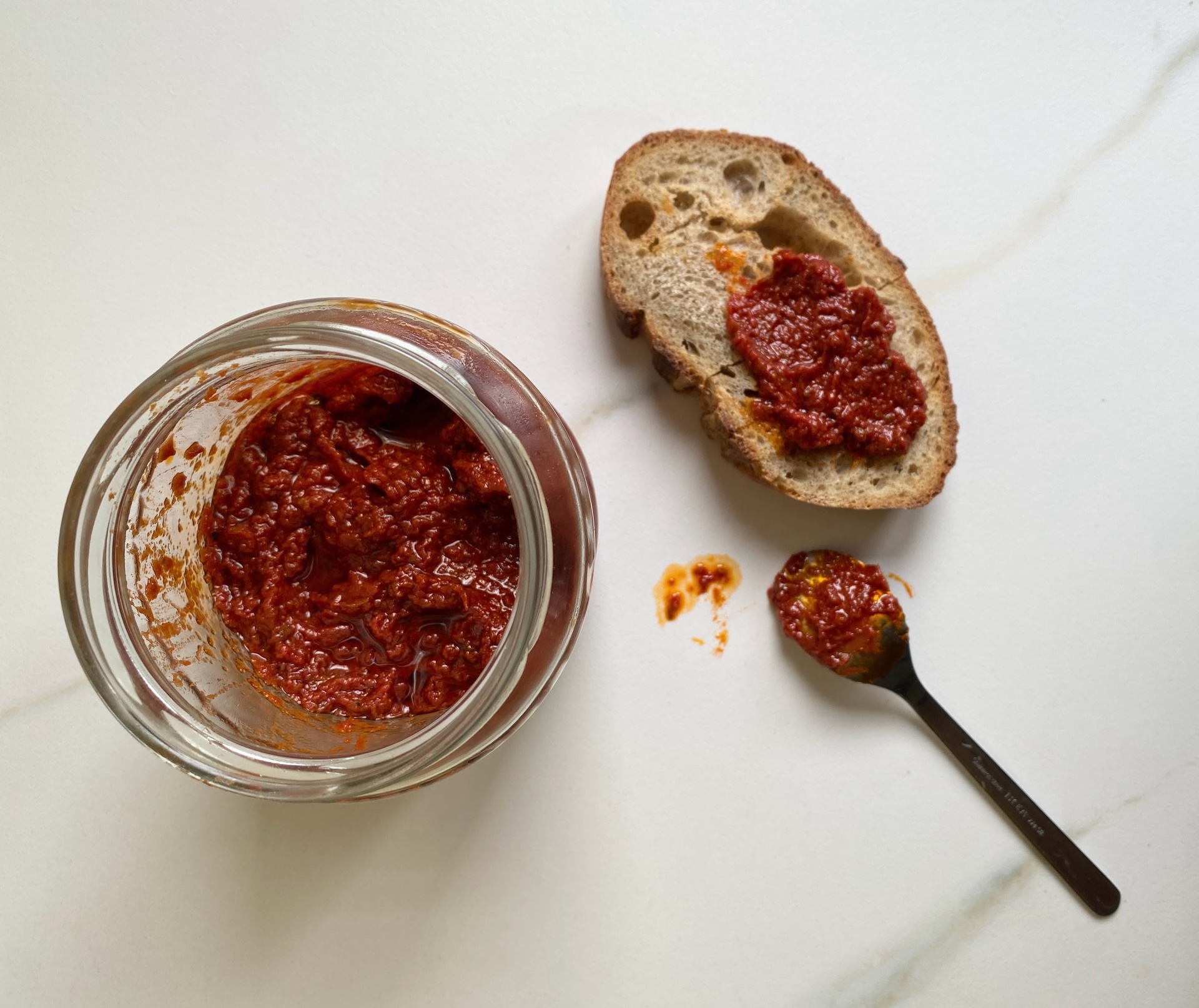
There was a dish though that stood out in that lovely lunch: a savoury salsa rossa, a red sauce, served on crostini. The menu prosaically called it “salsa rossa garfagnina” (red sauce from Garfagnana) and the owner-cook told me it was typical of the area. Both ingredients and method were basic: anchovies, capers, tomato paste and olive oil (“…simple olive oil, not extra virgin: too strong …”, she advised me), blitzed in a food processor. All this was music to my ears.
Back at home, I rummaged through my books to learn more and unexpectedly (I confess I had some doubts about its “authenticity”), I found it well described in the classic “La cucina di Versilia e Garfagnana” (1990) by Mariù Salvatori de Zuliani, one of the most solid sources on the cooking of those regions.
She calls it “Salsa rossa alla Carlino”: the Carlino in question is a restaurant in Castelnuovo di Garfagnana (the main town in Garfagnana), which opened, I believe, in 1964 and is still in operation.
“This sauce can be served to accompany boiled beef, but it’s also recommended as an appetizer, spread on homemade bread… as an accompaniment, a good dry white wine from the Castelnuovo di Garfagnana area is advisable,” wrote Mrs. De Zuliani. How can one argue with that?
Salsa rossa alla Carlino
3 fresh bay leaves, with the central vein removed
1 clove of garlic
50 g of salt-packed capers, rinsed
75 g of salt-packed anchovies, cleaned
The juice of half a lemon
250 g of tomato paste, preferably triple-concentrated
Extra virgin olive oil mixed with seed oil, as needed
Blitz the bay leaves, garlic, capers, anchovies, lemon juice and tomato paste in a food processor.
Then add oil to achieve a texture that Mrs De Zuliani describes as “Liscia e cremosa”, smooth and creamy. Exact quantities of oil are not really crucial here.
Let it rest for at least a couple of hours before consuming, although I think it’s better after 24 hours in the fridge.
It keeps for many days.
I enjoyed this sauce first the way I had it at the Locanda Belvedere, on toasted bread, then I used it on halved hard-boiled eggs, for a delicious retro antipasto.
I made this sauce first with salted anchovies and salted capers, then using oil-preserved anchovies and capers in brine – it always works. Perhaps the former is marginally better than the latter.
I own the 1990 edition of Mariù Salvatori de Zuliani’s book: this second edition added 211 recipes compared to the first edition of 1970. I’m not sure if this sauce was included in the first edition of the book.
___________________________________________________________________________________
Salsa rossa alla Carlino
Dicembre 2025, ricordando una gita in Garfagnana fatta l’autunno precedente.
Il novembre scorso, in una fredda ma limpidissima giornata, decidemmo di fare un gita in Garfagnana, per ammirare i colori autunnali dei boschi, prima che l’inverno li azzerasse.
Da Lucca, la destinazione era Sillico, un paesino di un centinaio di anime, a circa 700 metri di altitudine, nell’appennino tosco-emiliano.
Appena arrivati e scesi dalla macchina, il profumo della legna bruciata nei camini e l’aria frizzante, ci suggerivano senza ombra di dubbio che non era il caso di fare gli spiritosi: bisognava coprirsi per bene. Dopo due passi nel borgo deserto, entrammo nella locanda Belvedere, il cui nome e le cui foto in rete, mi avevano fatto ben sperare. Sapete quando si entra in un locale per la prima volta e si sorride fra se’ e se’ perché si avverte immediatamente di essere stati baciati dalla fortuna e di essere capitati nel posto “giusto”? – ecco, la locanda Belvedere suscito’ quelle emozioni.
La stufa accesa in un angolo, la classica credenza di legno ad una parete, il brusio soddisfatto di comitive gia’ sedute e attovagliate: tutto faceva presagire bene. E cosi’ fu.
Il menu’ scorreva sui binari soliti per questo tipo di locale: pecorino e prosciutto di montagna, giardiniera, funghi fritti, sformatini di verdura, tagliatelle al ragu’ e ai funghi, l’immancabile cinghiale in umido con polenta, crostata con noci e fichi.
Quello che scegliemmo si rivelo’ buono, piatti che esprimevano un concetto di cucina che e’ quella che io ormai preferisco: niente “effetti speciali”, ma soltanto la voglia di fare stare bene chi e’ a tavola, riuscendoci appieno.
Di questo pranzo ristoratore ci fu pero’ anche un particolare di cui tutti cantammo sperticate lodi: una saporitissima salsa rossa, servita su dei crostini. Il menu la chiamava genericamente “salsa rossa garfagnina” e la cuoca-proprietaria mi spiego’ che era tipica della zona. Ingredienti e metodo erano elementari: acciughe sotto sale, capperi, concentrato di pomodoro, olio di oliva (“non extravergine, troppo forte”, mi disse), tutto frullato assieme – musica per le mie orecchie.
Tornato a casa, scartabellai i miei libri per saperne di più e, inaspettatamente (lo confesso, avevo qualche dubbio sulla sua “tipicità”), me la ritrovai ben descritta nel classico “La cucina di Versilia e Garfagnana” (1990) di Mariu’ Salvatori de Zuliani, una delle fonti più solide sulla cucina di quelle parti. Lei la chiama “Salsa rossa alla Carlino” e il Carlino in questione e’ un ristorante di Castelnuovo di Garfagnana, aperto nel 1964 e che e’ ancora in attività.
“Questa salsa puo’essere servita per accompagnare un bollito di manzo, ma e’ consigliabile anche come antipasto, spalmata su crostini di pane casalingo…come accompagnamento e’ consigliabile un buon vino bianco secco della zona di Castelnuovo di Garfagnana”, scriveva la signora De Zuliani. Come darle torto?
Salsa rossa alla Carlino
3 foglie di alloro fresco, rimuovendo la vena centrale
1 spicchio d’aglio
50 g capperi sotto sale, sciacquati
75 g di acciughe sotto sale, pulite
il succo di mezzo limone
250 g concentrato di pomodoro, meglio se triplo
olio extravergine di oliva mischiato a olio di semi, q.b.
Frullare l’alloro, l’aglio, i capperi e le acciughe, il succo di limone e il concentrato di pomodoro.
Aggiungere poi tanto olio quanto sia necessario per ottenere una salsetta “liscia e cremosa” , come dice la signora De Zuliani.
Fatela riposare per almeno un paio di ore prima di consumarla, anche se penso sia migliore dopo un riposo in frigo di 24 ore.
Si conserva per giorni e giorni.
Io l’ho prima gustata su del pane tostato, poi anche su delle uova sode a meta’, per un ottimo antipasto un po’ retro’.
Ho preparato questa salsa sia con acciughe e capperi sotto sale, sia con acciughe sott’olio e capperi in salamoia: il risultato e’ sempre buono (forse la versione “sotto sale” e’ leggermente migliore).
Io posseggo l’edizione del 1990 del libro di Mariu Salvaori de Zuliani: qui furono aggiunte aggiunte ben 211 ricette rispetto alla prima edizione del 1970. Non so se questa salsa fosse presente nella prima edizione del libro.
______

 Italian home cooking
I very much look forward to making this soon, Stefano. It’s very different from the salsa rosa I make at home, which makes this recipe all the more appealing! I hope you have a merry Christmas and I look forward to more of your recipes in the new year.
LikeLike
That looks and sounds delicious and a fabulous Locanda too! I wil definitely be making this over Christmas as an antipasto.
LikeLike
thanks – an excellent discovery
LikeLike
Your writing is so beautiful! The tomato sauce/paste sounds exquisite!
LikeLike
thanks. It is one of the best discoveries, of late.
LikeLike