Delicious, easy, filling and impressive – this is what a well-to-do 1920s Italian middle-class family would have thought of this dish, I presume. It is a timbale, not dissimilar from a British savoury pudding: the “crust” is made with mashed potatoes, seasoned with butter and Parmigiano; the filling is finanziera, a traditional, now rare, ragout of veal offal and chicken giblets, often enriched with ceps or even truffles. Continue reading “Timballo di patate alla finanziera – Potato, chicken liver and sausage timbale, a 1928 middle-class dish”
Brasato lombardo – braised beef Lombardy style

I prefer to cook a brasato in the oven, at low temperature, at least one day before I want to eat it. Pre-salting the meat is crucial, ideally 24 hours before cooking it.
In the Italian fashion, I use a solid piece of meat that I ask my butcher to tie with string into a solid shape, rather than cubes – this way there is less risk of overcooking the meat and the size allows for a prolonged period in the oven. The alchemy of time and gentle heating delivers rich, deep flavours. Continue reading “Brasato lombardo – braised beef Lombardy style”
Tiella di verdure – vegetable and rice bake, from Puglia
This is a good summer dish from Puglia, a vegetable and rice bake, rich with oil and pecorino cheese, at least in my book. Tiella comes from the Latin tegella, which basically meant “oven tray”. Continue reading “Tiella di verdure – vegetable and rice bake, from Puglia”
Pizzelle napoletane – Neapolitan fried small pizzas
Pizzelle, fried small (ish) pizzas, are iconic and beloved Neapolitan street food whose strong hold on Italian popular culture has been assured for ever by being the protagonists of a legendary sketch in the movie L’oro di Napoli (The gold of Naples, 195 ) where a young and voluptuous Sophia Loren plays a flirtatious pizzaiola, a pizza maker, whose pizzelle as well as her prosperous bosom are legendary in the neighbourhood. As she fries the pizzelle she shouts: “…Scialate…scialate…Mangiate oggi e pagate fra otto giorni…” (Enjoy…enjoy…eat now and pay in 8 days’ time…”).
They are also firmly rooted in local home cooking though. As a kid, I used to spend a couple of weeks every summer in Salerno, not far from Naples and I clearly remember pizzelle being prepared by relatives: what a feast, for a little Milanese kid, whose mother was a reluctant cook and who would never embark in any deep frying. My aunt’s pizzelle were simply dressed with a a little tomato sauce and a sprinkle of parmesan: stuck one on top of the other, they would be kept warm in the oven, ready to be devoured with gusto after an exhausting morning at the beach -they are amongst my strongest food memories. Continue reading “Pizzelle napoletane – Neapolitan fried small pizzas”
Caponata di sedano – celery caponata

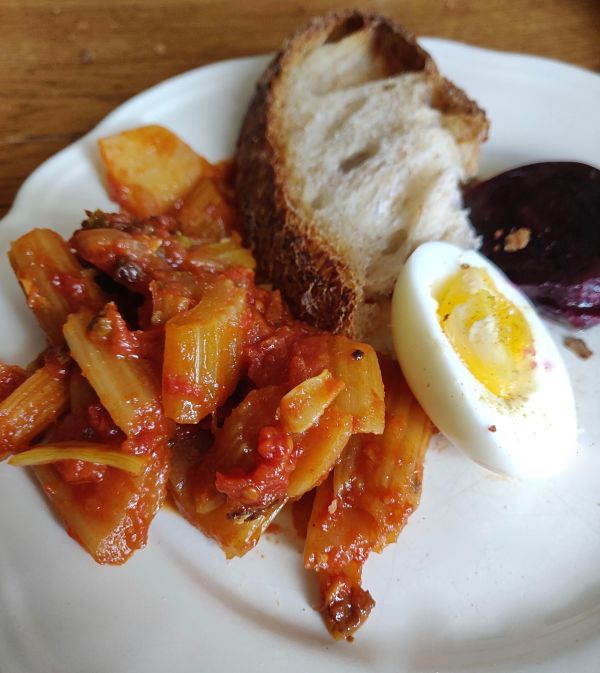
Celery is one of the main ingredients in the classic summer aubergine caponata. Few days ago, I thought of making it the protagonist, foregoing the aubergines (not in season now, of course) and the result was excellent
Please read my post on caponata first. This is just a note to myself, not to forget this dish
First I made the sauce from my caponata recipe.
Meanwhile I stringed a large bunch of celery (whichI had placed in cold water for few hrs). I then cut it up in thickish slices.
When the sauce had simmered for about twenty minutes, I added the celery and let it cook, uncovered, stirring occasionally.
The caponata di sedano was rested for 24 hrs and eaten the following days. Delicious.
Update December 2024:
For a large bunch (Italian supermarket size, with leaves) I made x 2 caponata sauce and the result was very good, more like a chutney (pls read below); the sauce was well reduced before adding the celery;
Spices: I (erotically) used the spices for Neapolitan rococo biscuits, and the result was very good;
On (over) cooking the celery: I did overcooked the celery; the following day, when the caponata was good, I decided to chop it up coarse lay – this was smart and transformed the dish in a sort of chutney; I WONDER IF/NEXT TIME: maybe it is better to simply blanch the sliced celery in boiling water and refresh it, then add it to the simmering sauce for few minutes only …??
On cutting the celery: perhaps, slicing the celery not too thickly is actually better